Showing posts with label Google. Show all posts

Sunday, January 15, 2012

KBO.CO.KE: Mocality catches Google Red handed in a marvelous sting

Google Kenya has been busy building its Get Kenyan Business Online outfit, and by all appearances, it appears to be a smashing success. The company is busy building websites for Kenyan companies at a cost of Ksh.2000, a package that comes with a unique .co.ke domain.

But how does Google access the database of all the Kenyan SMEs? It simply scraps the data from Mocality website and dupes Mocality clients into believing that the two are actually partners and in some cases telling untruths about Mocality. Mocality is Kenya's largest business directory, with over 170,000 verified businesses listed and has been busy building a trusted database of Kenyan businesses for the last few years, in the process employing hundreds of Kenyans and helping others generate income. Mocality builds its database through crowdsourcing but in fact, in the past, I have met several Mocality employees physically visit business premises and verify information on location, contacts etc. Mocality is something that has been built with the "sweat of the brow".

In scraping the data and selling its KBO service to Mocality clients, Google has in fact contracted an Indian company, based in India. Kenyan business owners were receiving calls at first from Kenya then from India with offers for a Ksh.2000 website. This is the most painful part of this unfortunate episode, this at a time when thousands of young smart Kenyans are unemployed! To read more about this story and the marvelous sting operation, visit the Mocality Blog here. To be honest, I cannot tell the story as impressively as they do it.

Work can be republished with attribution. Email Us africadomainnames@gmail.com

Monday, December 19, 2011

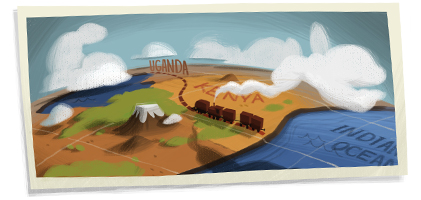
Google Kenya Celebrates 110 Years of the Completion of Kenya-Uganda Railway!

Have a look  at this. This is something historic and significant for our country and region. It is the Google's Doodle for Today, 19th December, 2011 celebrating the 110th anniversary of the completion of the Kenya-Uganda Railway. On 19th December, 1901, the Kenya-Uganda Railway was completed to open the interior of East Africa to commercial exploitation and easier administration of the Britain's then East African empire. Many of us forgot these major milestones of our history as soon as we left school. In a way, much of Kenya's colonial/ pre-independent history has been swept under the frilly doilies. For many of us, the history of Kenya begins in 1963...anything beyond that is too humiliating to be remembered.

But the Kenya-Uganda Railway was a human achievement and still exists in its original form. None of the Governments in East Africa have made an effort to construct new rails or upgrade the existing rail infrastructure and am sure none of us remembered today marked the 110th anniversary of the completion of the railway. But Google remembers. The search engine has found many ways to connect with Kenyans. I think the Google Kenya people are doing a great job integrating Google into our daily lives.


Work can be republished with attribution. Email Us africadomainnames@gmail.com

Thursday, December 1, 2011

Google delivers a final death knell to the dirty Domain parking Business!

I have always said this again and again, domain parking is the laziest, greediest, least creative, least innovative and an unethical way to use domain names. Domain parking has been a fuel behind the growth of the web and the DNS industry for a long time, with the domain investors registering or "snapping" hundreds of thousand of domain names and then "flipping" them or serving PPC ads on those domains. Flipping is the term "domainers" use for easy big sales of domain portfolios. But now Google is about to strike a final nail in the coffin of the domain parking industry which has been on a downward trend in the last few years anyway.

In a statement released on Google blog, the search engine has introduced a new “parked domain” classifier which will  allow Google crawlers to easily detect parked web pages and eliminate them from SERPs. According to the search engine, "Parked domains are placeholder sites that are seldom useful and often filled with ads. They typically don’t have valuable content for our users, so in most cases we prefer not to show them." Under this new regime, domain parking companies like Sedo will have to implement new rules .Google has forced the companies to remove URL forwarding and use DNS instead for parked domains. This means that if you park your domains with Sedo for example, instead of just forwarding the URL, you will have to modify the nameservers with your registrar by adding the Sedo nameservers ns1.sedoparking.com  ns2.sedoparking.com to give Google an easier time deindexing your domain, which should not have been indexed in the first place.

I think the people who purely park domains want to have the best of both worlds sometimes. They are too lazy or too busy to build meaningful content or business around their domains so they want to park them and rely on the theoretical 15%(highly disputable) of web users who access information via typing in URLs while at the same time, they want to rank for keyword-based search engine traffic by the remaining 85% (in fact over 95% i think) of web users who use Google, Bing and other search engines to locate content. Users are always fed with lots of links that add zero value to their lives. In fact, if there's one industry that has heavily contributed to the user awareness of ads and subsequent low click through rates(genuine clicks) in the online advertising industry, it's the parking business!

 The domain parking industry has also fueled typosquatting. A domain investor knows that a user is likely to type domian.com or domina.com instead of domain.com at one point in their browsing lives so why not lay the trap in advance? And if it earns me cash, why not go ahead and "typosquat" all the famous brands? This  is the dark side of domain parking. The temptation for typosquatting and even cybersquatting is just too hard to resist. In fact some of the domain parking greats engage in serious typosquatting and cybersquatting activities!

To give the devil its dues, domain parking has contributed to growth of many registries and generated good income for registrars, Google, Yahoo, ICANN and the investors themselves but they are of zero benefit to users! In essence, domain parking has been very useful for the DNS Industry but not the web users who need services from the DNS industry.

It's a complete and total waste of the cyberspace. Imagine land investors in your city buying up the prime property, with the best location and accessibility and then instead of building amenities, office blocks and skyscrapers, they sell space for outdoor advertising companies to put up billboards so that when you need office space, or a restaurant or park to take a rest in, you have to travel 30km out of the city centre! That's what the domain parking business does to our web. They force the rest of us to travel 30km out of the "city" to access services.

The parking industry was initially fueled by the PPC ads served by ad networks like Yahoo, Google and other networks. This has been the key monetization strategy although lately, the revenue from these ads have been on a nose dive. Gone are the nostalgic days of Kevin Ham, Frank Schilling, Yun Ye and others. Domainers who made millions of dollars from the domain parking business. Today's "domainer" must build content over several domains in order to earn something while reminiscing of a once "beautiful" past. In essence, it creates more value for the rest of us as more parked domains are converted into vibrant websites. With Google's new algorithms, this "kaizen" will be accelerated further for a more useful, ethical and quality web!


Work can be republished with attribution. Email Us africadomainnames@gmail.com

Monday, October 17, 2011

Cover trends early and well, Google is a fair master

Cover trends early and cover them well and Google will reward you abundantly. Many times when something occurs, you will notice major websites publishing a huge screaming headline but when you click, there is no news. They have mastered Google.

Google rewards the early birds, but quality eventually counts. If you publish trash the minute something occurs, the guys who take their time to analyse and write authoritative pieces will eventually displace you.
Play smart. Write a screaming headline so that you are the early bird. Then sit down and write something worth remembering. You will be unbeatable.


Email Us africadomainnames@gmail.com

Why it's important to host your content in your country code TLD

Geographical awareness: Google knows when you cross the border 

Google is location aware. I read an interesting story of a friend who was doing a "ccTLD domain experiment". He stays in the Netherlands and owns a Belgian domain in .be and lives close to the border with the Belgium or in his own words, "in the shadow of Google"

In his native Netherlands whose ccTLD is .nl, his website was nowhere to be seen. But a Dutch website offering almost a similar service appears on top but on crossing the 1km border into Belgium and searching for his niche content in Belgium his .be website ranked first on Google.

Hosting your content in your country's domain increases the chance of the relevant users in your country finding your content and products online. In fact, it's easier for you to rank well in your local ccTLD than in a .com or .org domain name in your country. Just using a .co.za or .co.ke radically improves your rankings before even adding SEO tweaks. Using the ccTLD is better for local search, branding and building trust amongst their local clientele and you get a chance to curve your niche. Countries with high online populations like Kenya, South Africa, Nigeria will especially reap well from their namespaces. Since the .com space is "dark, dingy and crowded", cctlds can be the next investment frontiers. Registering the generic domain names of popular generic name .com websites in your own country code can be a shortcut to Eldorado. Keyword.cctld is therefore a route to the top. It's interesting how the situation will obtain with the new continental domain like DotAfrica;infinite possibilities!

Email Us africadomainnames@gmail.com

Google Trader Launched in Kenya

The last month or so has seen Google launch product after product on the Kenyan market. Google has now launched its latest service in Kenya, Google Trader. Google Trader is a free online classifieds service that allows people to buy and sell products and services, as well as search for jobs online. Google trader is likely to face fierce competition from the classifieds websites in Kenya, primarily Naspers' Dealfish which has become a household name in Kenya and the leading classifieds website in the country. Dealfish also allows users to post and search adverts for free.

Which service will consumers trust more? Dealfish or Google Trader? I have been using Dealfish for almost one year now and apart from the ubiquitous and monotonous ads all year round, it's an excellent and trusted classifieds website that has consistently delivered to me what I want and is free of spam. I will test and see if Google Trader offers me the same kind of top quality and delivery in the online marketplace. Now there is an even bigger platform for Kenyan buyers and sellers to conduct online commerce. Good for Kenyan online consumers!


From the horses' mouth:


After the pilot launch in Uganda and the exciting launch in Ghana, we are excited to announce the launch of Google Trader in Kenya. Google Trader is a free classifieds service that allows people to buy and sell products and services, search for jobs or just about anything else they are looking for.


.

During the last few weeks, thousands of businesses have posted tens of thousands of listings across different categories. There is a rich and growing collection of jobs, cars for sale, phones, electronics, books and a lot more. Anyone, individual or small business, can post for free and reach millions of Kenyans who search online for products, services or jobs.

Check out Google Trader in Kenya today at www.google.co.ke/africa/trader on your computer or mobile.


Email Us africadomainnames@gmail.com

Monday, October 10, 2011

DCA in the News: Is Google Good for Africa?

 Article Republished from DotConnectAfrica Press Update. Link to Full Story on the Africa Report Website.

The Africa Report is a monthly magazine based in Paris France, which is the English version of the highly respected "Groupe Jeune Afrique", which has been the leading economic, political and cultural media throughout Africa and worldwide. 

The Africa Report thus provides more than 400,000 African and international readers with expert analysis of Africa's fast-changing political and economic landscapes.It has established itself as the international publication of reference dedicated to African affairs.  It is the guide used by decision makers to anticipate economic and political changes in Africa and relied upon for the expertise of an independent editorial team in its surveys, sector reports and country focus published in each issue.  Its recognized high-quality coverage of the African business environment is combined with the widest pan-African and international circulation.

Is google good for Africa?   WRITTEN BY GEMMA WARE IN DAKAR:   
  
Africa Report Cover

As the influence of companies like Google grows, the continent's techies are aware of the urgency to stake their own territorial claim.
 
An African-led initiative is pushing for a .africa suffix aimed at breaking down the dominance of foreign hosting sites.  Around 90% of African websites are registered as .com, says DotConnectAfrica's Sophia Bekele. When it costs $19 to register a .com site versus around $50 for a .co.ke in Kenya, the choice is obvious, but it is not helping to populate the African web. 

With an eye on its future profits, Google is investing millions to enable an army of tech-savvy young Africans to build the web from the bottom up and put their continent on the global information map.
 
"The problem with Africa is that there isn't enough information," Carlo D'Asaro Biondo, one of Google's vice presidents for the region, told the crowd. In front of him, laptop screens flickered in the dimly lit lecture hall as rows of young Senegalese techies tapped away at their keyboards. On stage, large breeze blocks in bright primary colours lay piled up in pre-planned abandon. One event in the US tech giant's G-Africa series, the G-Senegal meeting in late February brought together more than 600 web developers and HTML-literate IT students at Université Cheikh Anta Diop. They are all part of Google's plan to create an African army to help it build the web from the bottom up.

Google has Africa firmly in its sights. As new fibreoptic cables bring down the cost of bandwidth, and manufacturers race to bring out affordable smartphones - the most basic of which still costs about $100 - the internet is going mobile in Africa. Already 40% of Google searches on the continent come from internet users on mobile phones. Google expects user numbers in Africa to grow from 14 million in 2010 to 800 million by 2015. Mobile information has been the midwife to the uprisings across the Arab world. Videos, photos and comments posted on Facebook, Twitter and Google-owned YouTube fanned the flames of revolt.

Seen from the Googleplex back in California, Africa remains a big, perplexing blank, an obstacle in the way of Google's brazen goal to organise the world's information. But it has seen the future - one that will hold 43 million middle-class Africans by 2030, according to the World Bank. By investing now into Africa's internet ecosystem, Google hopes to hardwire it with tools that will make people click through to its websites.

While there is an average of one web domain for every 94 people in the world, there is only one for every 10,000 Africans. An empty web with less local and relevant content means fewer reasons to go online and a dearth of revenue for Google, which principally earns money by selling targeted advertising on its search engine.

It is also embedding itself in the internet's evolving geopolitics. As authoritarians tighten their media-monitoring screws, buying military-calibre cyber surveillance software, Google will be monitoring them. Since 2010, Google has been publishing statistics on the requests it receives from governments to remove information from its websites. During Egypt's February revolution, the tracker clearly showed when the country's internet was cut. As part of its response, Google put to use a start-up called SayNow that it had acquired just a few weeks before to create a 'speak-to-tweet' service. It allowed Egyptians to leave voicemail messages that were posted on Twitter as audio files.

The company has won fans - and sceptics - for its 'don't be evil' motto. It got burnt in China and its reputation suffered after it agreed to censor search results. It will not be doing that again in a hurry. But by shining a light on censorship, Google has helped democracy activists expose politicians who meddle with the freedom of information. In late May, an Egyptian court charged the ousted President Hosni Mubarak and two of his ministers $90m for cutting telecoms services.

During the revolution, Egyptian activists were fearful of what US multinationals might do with their private information. "Anyone who holds this amount of information needs to be very careful with it," says Nadine Wahab, an Egyptian activist behind the "We are all Khaled Said" Facebook group. But when Google's property is attacked, it will make noise. In June, the company pointed the finger at the Chinese government after disrupting attacks on Gmail users, including US government officials and Chinese political activists.

Google's play on the continent is seductive and transformative. It has launched dozens of projects in Africa. Its search engine is now available in 31 African languages, including Ewe, Sesotho, Wolof and Amharic. A $1.25m project will digitise Nelson Mandela's documentary archives. Another pilot in Nigeria - the Get African Business Online project - is helping small businesses to build websites. Google runs mapping projects to help chart unmapped areas (see box page 22). It is also forging relationships with Africa's more tech-savvy administrations. A web facility tailor-made for Kenya's treasury is helping constituents monitor the implementation of infrastructure, education and health projects launched under the government's Economic Stimulus Programme.

Google's assault on Africa is coming at a time when the company is facing growing hostilities elsewhere. In late March, its plan to monetise 15m digitally scanned books for the Google Book Project was barred by a New York court. Meanwhile, the European Commission is probing whether Google is abusing its dominant position in online search by prioritising its own services.

MISSION: CREATE CONTENT Google's push to create local content is not unique to Africa and it forms a central part of its expansion strategy into emerging markets with low internet penetration. So far, the coast has been relatively clear. While its biggest rival, Microsoft, has an established presence in Africa, Facebook and Twitter have not yet defined strategies for the continent. Yahoo email addresses are still commonplace across both anglophone and francophone Africa, but Google has pretty much won the battle for African search.

Back in Silicon Valley, it used to be hard to get attention for African projects. Now, it is a different story. "If you do something that's involved in Africa, it's a very feel-good thing around Google," says Steven Levy, author of a new book on Google called In the Plex. Google, which is famed for employee perks such as free gourmet food and onsite medical care, allows its engineers to use 20% of their time on other projects. "What Google is doing in Africa is very sexy," says the firm's Senegal representative, Tidjane Deme.

Off the back of a successful final quarter of 2010 - which brought in profits of $2.5bn - Google is in the midst of an Africa recruitment drive, with more than 30 posts open across the continent.  Its staff in Africa has grown from 10 in 2006 to 65 today. In December, it secured a huge coup by poaching Kenyan Ory Okolloh - founder of web platform Ushahidi and a prominent blogger and activist - as its first policy manager for Africa. The usually ebullient Okolloh has remained tight-lipped since she started, and declined to give an interview to The Africa Report.

WE COULD BE HEROES  African googlers have begun to get themselves noticed. At first, Google was unsure how to react to the swell of admiration for its marketing executive Wael Ghonim, held aloft as a hero of the Egyptian revolution after his detention at the hands of the security services. "They were conscious, as a global corporation, of the implications of this," says Levy. But they realised soon enough the value of his profile-raising. On 12 February, five days after his release, Google's official Twitter account said: "We're incredibly proud of you @Ghonim & of course will welcome you back when you're ready."

Others are going on to great things. Kenyan Nyimbi Odero, Google's former lead for West Africa, told The Africa Report he saved the Nigerian Electoral Commission around $100m in procurement costs with in-house voter registration software he and his team developed for 2011's elections.

Spreading its tentacles further and deeper into the world's internet is a fundamental part of Google's business plan. In the year to end December 2010, 41%, or $11.9bn, of its $29.3bn in revenue came from outside the US and the UK, up from 37% in 2008. Despite its push for global information-sharing and transparency, Google will not reveal how much it is investing in Africa, although it admits that it is not yet making a profit.

"Our business model works only when you have enough advertisements and a lot of users online, and that's the environment we are trying to create in Africa," explains Nelson Mattos, Google's vice president of product management and engineering for Europe, the Middle East and Africa (EMEA). "Right now the goal is not to be profitable. We are not focusing on sales except for South Africa, where you already have an environment of enough users online, enough traffic online and enough advertisers who want to take advantage of that. In the rest of Africa, it's about bringing people online and making sure that they take advantage of internet services first."

With a platform like Baraza - an online question-and-answer site that Google launched in October 2010 after success with similar pilots in China and the Middle East - users are persuaded to create content on a Google platform. "It has become extremely successful and we are starting to see a lot of the content that got created through the Q & A to surface in the Google search," says Mattos. Another beta project, Google Trader, launched in Uganda and Ghana, acts as a web and mobile marketplace for everything from rice-milling equipment to used Hondas.

Such crowd-sourcing is central to Google's global strategy. It stems from founders Larry Page and Sergey Brin's belief in an open-source internet model, where tools are made freely available to developers. It is the driving principle behind its Android smartphone platform, which now has over 150,000 apps, but - like its African investments - has yet to bring in billions in revenue.

Since mid-2009, Google has been busy moulding a new generation of bright, tech-savvy Africans who are incentivised to evangelise. Part of a growing young elite with the money to buy laptops, internet data bundles and smartphones, these geeks will rule Africa's online universe.

But while Dakar's Google Technology User Group (GTUG) - a 50-strong network of young developers that receives a stipend each month from Google to host meetings - may know how to work the tools, they have little financial support to create new applications. Ibrahima Dieng, one of GTUG's leaders, says: "People come and try things out, but they don't publish." Many are students, without the credit cards needed to buy space online.

LEARNING TO ADAPT Senegalese web engineer Hovi Kokuvi Amen Hovi says he is earning €11 a day from AdSense adverts hosted on two news-based websites he operates. He has been lucky - he can get at the money via a French bank account. Funds earned through AdSense used to be sent with a Citibank cheque in US dollars, a system not well adapted to serve developers in largely unbanked economies. In May, Google agreed to make payments via Western Union in Senegal.

Google has not yet made the biggest commitment it could to Africa - to build a data centre, the beeping heart of its web operations. However, it has set up several dozen caches with African mobile operators and internet service providers. So, when somebody wants to watch a YouTube video or access Google Maps, the request does not travel all the way to a European data centre, but is accessible via a local store.

Back in 2008, Google provided an undisclosed part of a $410m investment in O3b, a series of low-orbit satellites that would bring fibre-speed broadband to the developing world from 2013. Google also recently opened a point of presence (POP) in Nigeria to serve West Africa, effectively an entry point to its global network of data centres. There is already an active POP in South Africa, and Google plans to build one in Kenya to keep local traffic within Africa.

Just how Google plans to recoup such investments remains unclear. Some of its products could become lucrative if they reach critical mass. One is Gmail SMS, which allows Gmail users in certain countries to send 50 free text messages from their emails. When users receive an SMS to their inbox, they get another five free messages.

"They're sowing now so they can reap the advertising funds down the line," says Banky Ojutalayo, a former senior manager for value-added services at Glo Mobile Ghana. He suggests that once the service had built up a large enough user base, Google would consider selling short adverts at the end of each message - a potential goldmine.

African mobile operators' eagerness to team up with Google shows the power of its global brand. But sometimes the company falls foul of the higher standards it sets for itself. It was criticised last year for exercising loopholes to pay an overseas tax rate of just 2.4% in the US, cutting its tax bill by $3.1bn. Google insists that it "complies with tax law in every country in which it operates," including seven countries in Africa.

As the influence of companies like Google grows, the continent's techies are aware of the urgency to stake their own territorial claim. 
An African-led initiative is pushing for a .africa suffix aimed at breaking down the dominance of foreign hosting sites. Around 90% of African websites are registered as .com, says DotConnectAfrica's Sophia Bekele. When it costs $19 to register a .com site versus around $50 for a .co.ke in Kenya, the choice is obvious, but it is not helping to populate the African web.

Nigerian developer Saheed Adepoju, who launched his own version of Apple's iPad tablet called Inye last year, says some of his peers are worried Google is trying to take over their market. Adepoju tells them that they should not worry. "We know the local system better than they do. It's not going to be hard to compete with them."

Whatever its profit projections, Google's African advance is a long play. It sees that the continent is getting richer and more connected. Africa's sparsely populated internet is a money-making opportunity for Google and the army of African developers it is training to help fill in the gaps. Africa's future is an online and a mobile one, and Google has raised its flag first. 

Original Article

Email Us africadomainnames@gmail.com

Tuesday, September 13, 2011

Kbo.co.ke : Google Getting Kenyan Businesses Online

KBO.CO.KE 
One of the reasons Kenyan businesses have not been visible online is the cost of domain names, cost of webhosting, cost of web design and finally the technical hands to constantly update content on the website. The .KE domains are quite costly at Ksh.2900($35) per domain name and there have been loud calls in the past for prices of the domains to be reduced.

 A Kenyan business wishing to establish an online presence must have an initial investment of at least Ksh.50,000($590) to pay for web design and hosting, that's after paying the Ksh.2900 for a single .CO.KE domain name. Kenyan SMEs simply do not have these kinds of resources to invest in getting an online presence, they are considered avoidable frills to the small businesspeople in Kenya. But not anymore, especially with a price tag of $FREE.

Google to the Rescue
Google has been deeply committed to developing the African internet scene in the last few years;. It's more than a commitment but  a passion to get Africa online. We reported earlier on this blog that Google unsuccessfully tried to acquire the domain Africa.com less than two years ago in order to build a social network for Africa.

On July 05,2011 Google registered the domain kbo.co.ke with which it plans to get Kenyan Businesses Online, a domain name to give Kenyan Micro Enterprises an online boost and to get their businesses online for free. Partnering with KENIC, Equity Bank and Safaricom, this is Google's Gift to Kenya. This domain will soon be one of the most trafficked in the Kenyan namespace and has very simple Website Sitebuilder Tools.

Businesses will be able to register domain names in the fourth level for their businesses. For example, you can register http://chips.kbo.co.ke for your chips business; http://furniture.kbo.co.ke http://travel.kbo.co.ke http://insurance.kbo.co.ke etc for free, build your website and add the content and host it for free!! I think this is one of the best deals to have been launched on African ccTLD namespace! I can't just find any comparison to this when it comes to getting people online in Africa. You have a chance to register generic keyword sub-domains that will rank well because kbo.co.ke will rank very well as far as searching for Kenyan content is concerned.

The kbo.co.ke Business Sitebuilder is very simple to use and no web design and technical skills are required. I created a website in just 20 minutes without reverting to my web design skills. You can have a look at my kbo.co.ke website here, I used this just as a demonstration but the domain is available to anyone who might be interested in a building some online real estate in the .kbo.co.ke namespace for selling vegetables to Nairobians.

This is not the first time Google is launching an initiative like this and neither is the initiative limited to Kenya or Africa. A very similar initiative was launched early this year in Canada dubbed "Canada Get Your Business Online"(very similar to kbo.co.ke) to help small businesses thrive online. Google has been busy purchasing "Get Online" Domain names in the past few months such as GetOnlineColorado.com TexasGetOnline.com etc. Google acquired over 100 "Get Online"domains so this must be an ambitious plan by Google to get small businesses across the globe online. Other similar initiatives include the one launched in Ireland "Getting Irish Business Online"


Below are the screenshots of steps required in setting up a Website on kbo.co.ke $FREE: It's quite simple, all you need is a Google Account and you are good to go. Remember that you can only register one sub-domain name on kbo.co.ke, registering more than one sub-domain is a violation of KBO Terms of Service.

Create or Log in to a Google Account
Choose a Sub Domain Name


Describe Your Business

Voila!! Add Content and Publish Your Website!!

 Here is a nice video Promoting Google's "Getting Kenyan Businesses Online" Campaign:


Email Us africadomainnames@gmail.com